
Owning an Australian Cattle Dog
Heads Up: This page includes one affiliate link marked with an “*”. If you click and purchase, I may receive a small commission at no additional cost to you. But rest assured – my opinions are my own, I would never recommend something I haven’t or wouldn’t purchase for myself.
If you’ve been thinking about adopting your first Australian cattle dog (aka blue/red heeler), you’ve probably been told by some people that they are the best dogs in the world, while others may have scared you with a list of cattle dog behavior issues. So which is it? Well as I see it, a cattle dog can be the best dog in the world if you put in a lot of time with them up front, but if you don’t, they can live up to their nickname of “velociraptor”. I want to share with you my experience of adopting my first cattle dog and getting from “What in the hell did I get myself into?” to “She’s the best dog I’ve ever owned!”
Temperament of an Australian Cattle Dog
I’d like to point out that not all cattle dogs are the “typical crazy”; there are heelers out there that are more mellow. If you want to avoid the crazy then I recommend that you avoid getting a small puppy and instead get a heeler that is being fostered in a rescue. In these cases the foster parents can describe the dog’s personality. Unfortunately, there are a lot of Australian cattle dogs in rescue; I assume this is because people don’t really know what they are getting into when the adopt a heeler. If you live in the southeastern U.S., especially Florida, check out Ewenity Farms Herding Dog Haven rescue – they usually have quite a few pure bred heelers up for adoption and/or fostering.
How I Came To Own My First Cattle Dog
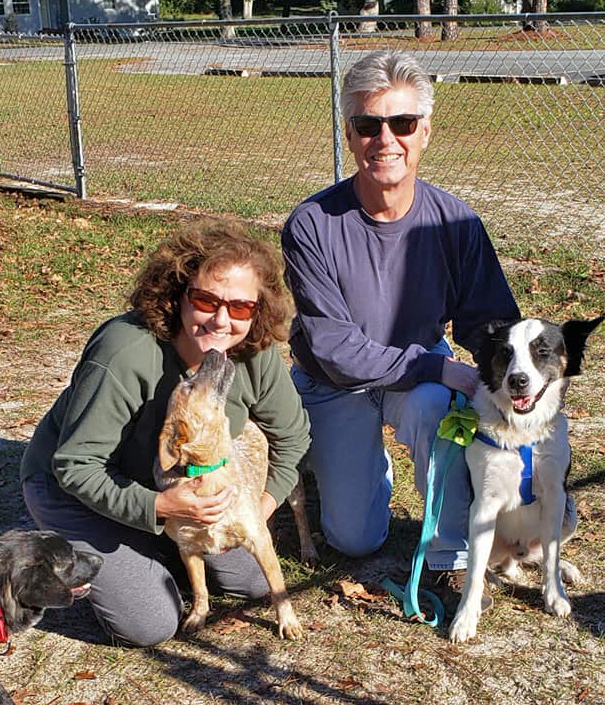
About 5 months prior to adopting my cattle dog (Josie), my husband, Mark, and I had adopted a supposed border collie mix (Jaxon) from Wags Rescue which is located in southern Georgia about 4 hours from where I live. I had always wanted a border collie (“always” meaning ever since I saw the movie “Babe”.) Well, Jaxon turned out not to be a border collie but was in constant want of attention, and it was starting to drive me and Mark a little crazy. So, we figured we should get Jaxon a playmate to keep him occupied. (Hindsight has shown that Jaxon didn’t actually want a playmate.) When another supposed border collie mix came up on Wags’ website, I thought that he might be the right choice. However, there was another dog that I’d been drawn to that had shown up on the rescue’s site on and off for nearly 6 months. That dog was a red Australian cattle dog named “Sashi”. I knew nothing about cattle dogs at the time, and the look of cattle dogs didn’t really appeal to me the way border collies did, but there was something about this dog and her “smile” that made me keep thinking about her. I told the head of the rescue (Kathy) that I wanted to meet Sashi as well as the supposed border collie. Kathy tried to discourage my husband and I by saying that Sashi was a typical heeler (ie. a very high energy dog), and since we didn’t have a big, fenced backyard at the time, Kathy thought that a heeler probably wouldn’t be a good fit for us. But I assured her since there was a dog park just a block away from our home, we could handle her. So Kathy agreed to let Mark and I meet Sashi as well as the “border collie”.
The next day 4 of us (me, Mark, Jaxon, and another dog we were dog sitting) made the 4 hour trip up to Georgia. When we arrived, we let Jaxon out of the car and Kathy went to get one dog at a time. Sashi was the first dog she let out, and Mark and I were both immediately taken with her. She was smaller than I imagined and so cute and friendly – coming up to us wagging her tail, then running after Jaxon wanting him to play. I felt like I didn’t even need to see the other dog. And when we were introduced to the supposed border collie, it was obvious that the red heeler was the right choice. I again had to reassure Kathy that we could handle her. Sashi had been twice returned to the rescue, so Kathy was quite protective of her. Thankfully, we got to bring her home that day and Sashi became our Josie.
Life with My Cattle Dog Before I "Tamed the Beast"
For the first couple of days, Josie was an angel but once she started to feel comfortable in our home, her real personality came out! And then it took more than 3 weeks for me to come to the conclusion that we hadn’t made a terrible mistake. I thought she was literally insane. But after assuring Kathy that we could handle her, I was determined not to give up – no matter how miserable I was!
I remember a few days in, sitting on the couch crying as she tore back and forth across the house, stopping only briefly to nip at me. She was barking, jumping over furniture, knocking things over and literally throwing herself against the walls.
She loved going in the car because she would herd cars as they passed by. She would scream and literally throw herself against the side window. It was so loud it would make us jump and scare us to death.
Our house was on a canal. We didn’t have a real backyard, it was simply a screened pool with walkways on either side leading to a dock, but the area was fenced in on all sides other than the canal. In order to keep both of our dogs from getting out of the “backyard”, we had to pile things on the sea wall where the fences ended. However, this wasn’t always fool proof. One time, after having Josie for only a couple of weeks, Jaxon managed to push open the barrier and Josie happily followed him and went after the yappy little dog next door. By the time I retrieved Josie, my next door neighbor had picked up his dog and Josie was leaping into the air trying to get to it. She ended up biting my neighbor’s finger (which I assume was an accident.) Well, that ordeal was pretty scary and as it turned out, going after small yappy dogs became a regular habit for Josie. And I later learned that someone picking up their dog made her even crazier.
There were also a couple of small dogs that lived directly across the canal from us. When they were in their backyard and Josie was in our backyard, barking usually ensued as soon as they saw each other. And if the barking got really heated, Josie would lose her mind and jump into the canal and swim to the other side, despite there being no way for her to climb out once she got there. The neighbor on the other side of the canal had to fish Josie out on more than one occasion. Needless to say, we couldn’t allow our dogs to be in the backyard unattended.
How I Got the Crazy Red Heeler Under Control
So you may wonder, how we got from the out-of-control Josie, to the well-behaved Josie. First, I had to find a way to get Josie tired. That was no easy feat. Mark and I walked her but that didn’t really tire her out, although it did wear me out because she was constantly pulling on the leash, either chasing after squirrels or trying to herd bicyclists. Also, nearly every day I took Josie to the dog park. Thankfully, Josie loved to catch balls. So, I invested in a chuck-it* and threw her a ball for between one and two hours a day. Josie only stopped running occasionally to take a quick dip in the doggie pool to cool off and then she was right back at it. And Josie didn’t just fetch the ball, she ran out and leapt into the air to catch it. She loves to jump!
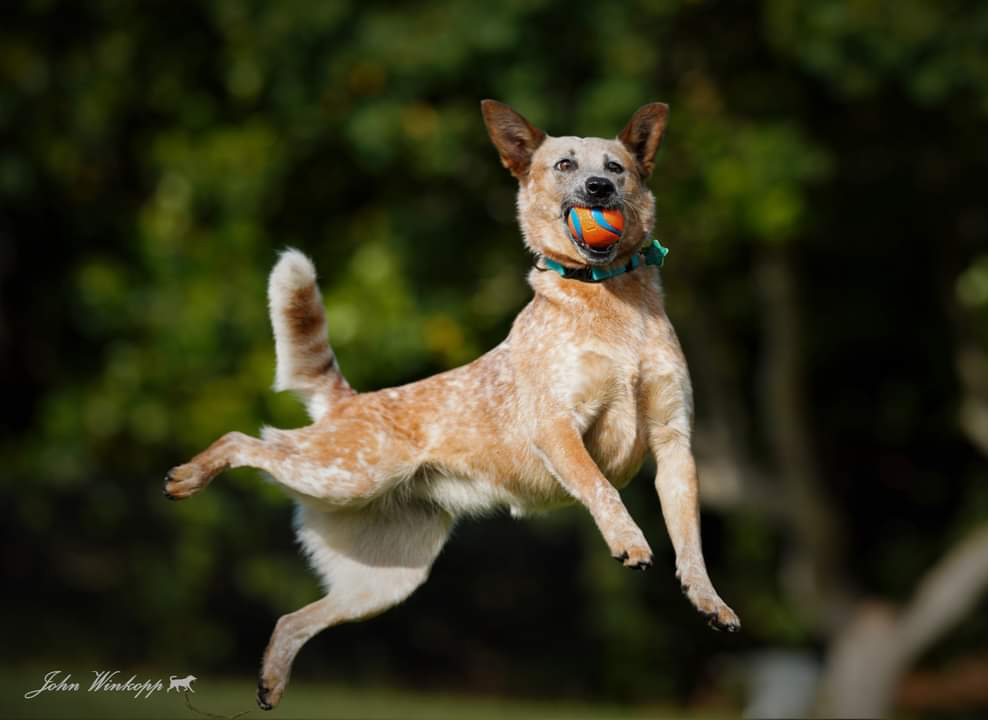
Photograph of Josie Courtesy of John Winkopp / Space Coast Pictures.
However, I knew that just tiring Josie out wasn’t enough to fully get her under control. She needed training. Right before getting her I had joined a local dog training club where I took classes with Jaxon. So I signed Josie up to start attending the weekly good Canine Good Citizen (CGC) class in the upcoming session. Thankfully, I had just gone through the class, so I could get a head start on her training. The CGC class was just the first step in a whole lot of training.
One of Josie’s habits that proved especially stressful for me was her barking. At the time we got her we ran an Airbnb rental that was attached to our home. In fact, although the rental had its own separate entrance, it sat on the other side of a locked door from our living room, so I definitely couldn’t have Josie barking inside the house. I’m not actually sure how I did it, but over the course of time, I managed to teach Josie not to bark (in most instances). I think it was a combination of building a strong bond with her (by doing things with her for hours every day), being consistent in correcting her when she barked, and praising/treating her when she didn’t bark while other dogs were barking. However, when Josie is doing “her job”, to this day, there is no stopping her barking because it’s part of her job and she knows her job is too important. Read more about Josie’s job in the box.
My Cattle Dog’s Job
You may have heard that cattle dogs (like most herding dogs) need a job to do. Before I got Josie, I never really understood that. I mean, how do you give your dog a job? What kind of job can they do? I knew I wanted to eventually do canine agility with her, but until then, what? Well lucky for me, Josie took the initiative and gave herself a relatively harmless job.
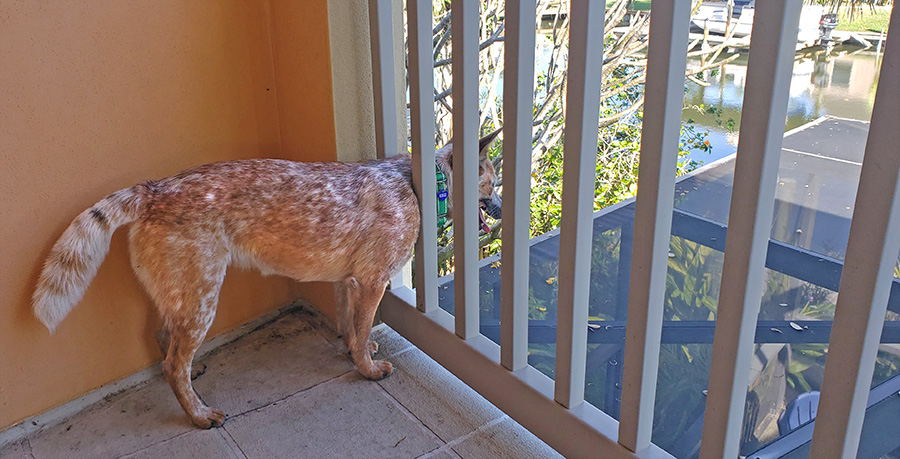
Our house had a second story with a long balcony that was adjacent to the top of our pool screen. While I spent most of my days working on my computer upstairs, Josie would be hanging out on the balcony. When I came out to check on her she was usually standing or lying with her head between the bars of the balcony’s railing, seemingly just enjoying the scenery. This became our daily routine. Josie would only bark occasionally when the dog next door started yapping or when she saw a squirrel. I eventually got her to stop barking at the other dog; however, if there was a squirrel on the screen, she would bark aggressively until the squirrel was gone. At first, the squirrels would quickly run away, but eventually they became immune to her barking, so I’d go out on the balcony and chase them away by spraying them with a hose. Then one day it dawned on me – Josie wasn’t just hanging out for hours watching the scenery, she had given herself the job of keeping squirrels off of the pool screen. And she took her job very seriously!
The bottom line is that turning a wild cattle dog from an out-of-control menace to an incredibly obedient companion was no easy feat. To summarize, it happened over the course of several months by me giving her lots of time, attention, and new experiences. It’s hard to say how much time I spent engaging with her on average each day, but at the beginning it was a lot. I took her to about 2 classes a week and the type of class varied throughout the year including classes in obedience, agility, and scent work. I threw her a ball for 1+ hours almost every day (when it was too hot, I threw it in the pool), did training exercises with her most days, engaged with her on and off throughout the day (I worked from home), and routinely took her with me to dog-friendly stores, outdoor restaurants, and community events. I even took her on a couple of girls’ road trips (just she and I), including one 9 day dog-friendly adventure that covered 3 states! And while most of the bad behaviour was over after a few months, there were still plenty of times that she’d lose her mind in a moment of excitement. But I feel like her impulse control really improved earlier this year at around 6 years old. She still has plenty of energy and silliness but she seems to be able to control it better now.
Why I Think My Cattle Dog is the Best
After reading this far I imagine a lot of people might think that a cattle dog really isn’t worth the effort required, but that’s not how I see it. Yes, getting my heeler under control took a lot of time and effort, but I would do it over again in a heartbeat because now I have a dog that is more obedient and devoted than I ever imagined was possible. The big question to ask yourself is will you have the time to invest in a heeler?
Here are a few examples of how devoted, obedient, and fun Josie is.
- Sometimes, when Josie really wants to bark at something, but I tell her not to, she literally chokes on her barks. It’s like she’s barking under her breath. This shows me how much effort it is for her to restrain herself.
- Josie now comes as soon as I call her, even when she’s chasing something.
- She is always eager to learn something new. I can tell agility isn’t her favorite thing, but she obliges me and we’ve been competing for several years. I taught her scentwork, and she gets right down to business when we are at a trial. She does tricks, dock diving, lure coursing, rally trials, and more.
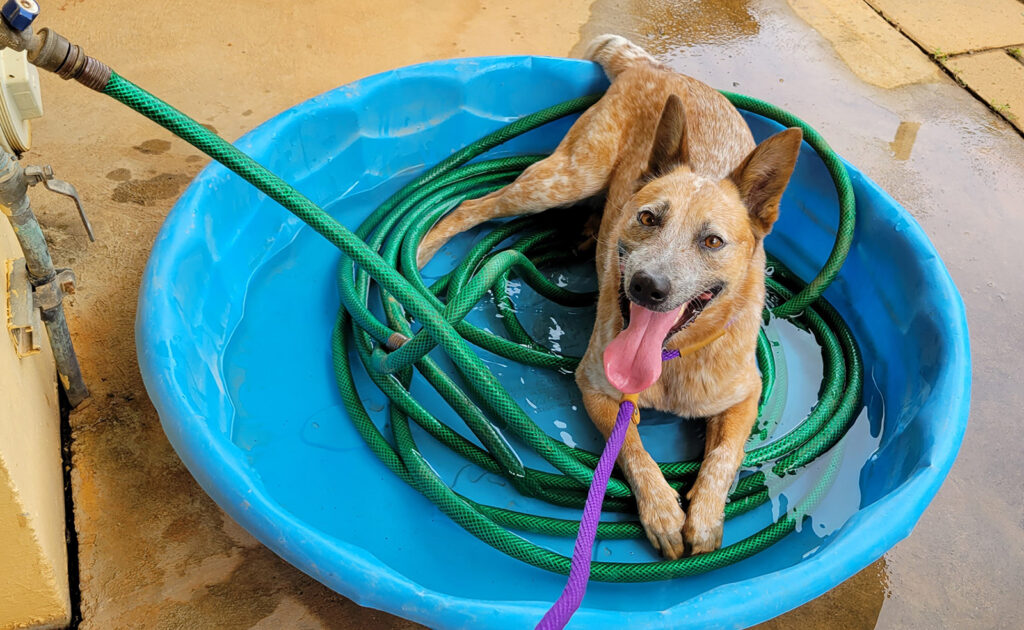
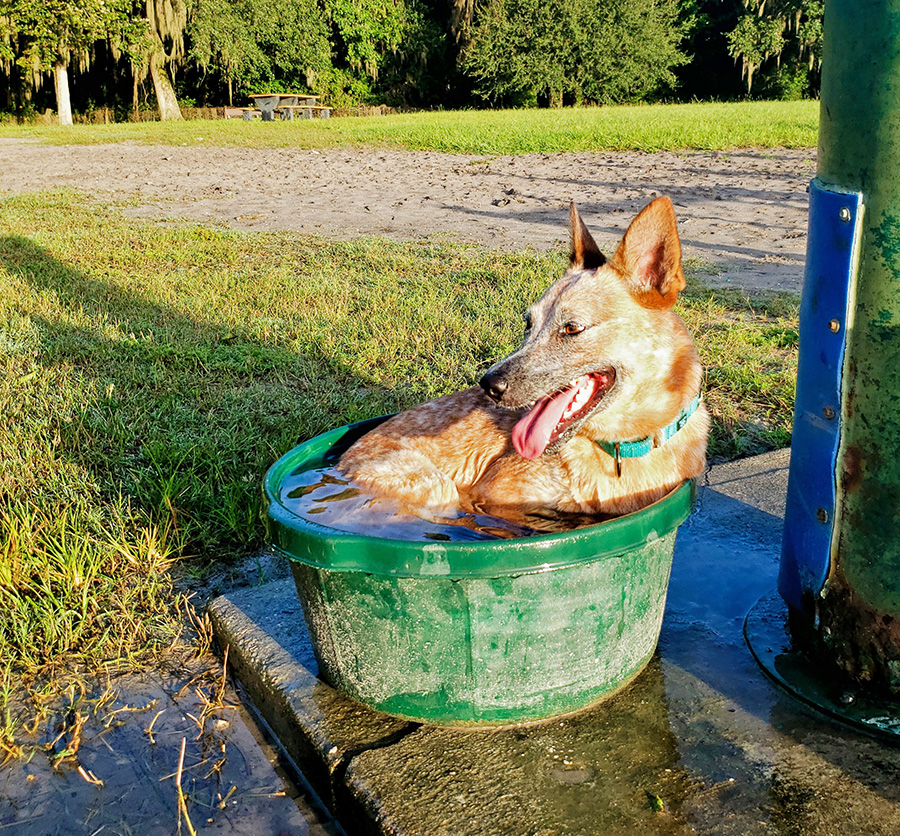
- She’s not a puppy, but boy does she make me laugh, like when she squeezed herself into a bucket of water because she was hot and that was the only option, or when she leaps over another dog to get to the ball first!
- Josie is such a sweetheart at the vet’s office. She is always so friendly there and she takes her pokes and prods without complaint. She’s like a fan favorite with the staff. Sometimes different vet techs will come into our exam room to say “hi” just because they heard that Josie was there.
- When my husband tells her to do something, she looks at me first to get my approval. (I don’t think my hubby likes this too much.)
- Although she is always by my side when we are both in the house relaxing, she is incredibly independent. She spends much of her days looking up at the trees in the backyard to make sure nothing comes down. And if she feels playful and brings me a toy, if I don’t have time to play, I just tell her “no” once, and she goes off and amuses herself, sometimes by just chasing her tail. (She still does this at nearly 7 years old to burn off excess energy.)
For me, it all adds up to me being one lucky dog mama! If an Australian cattle dog sounds like a good match for you, please consider adopting from a rescue – there are so many great heelers being abandoned because many people don’t research the breed before buying one.